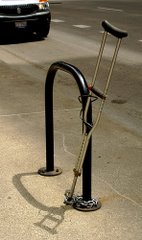
Wow, they beat the odds, they overcame adversity, they’re an inspiration to us all. They’re so courageous!
This is the usual positive way peoples with disabilities are portrayed in the media. The most prominent example is Christopher Reeve who the able bodied population admired because of his determined struggle to overcome his paralysis. But stories like his are commonly played in local news programs, magazines, or in TV shows.
Judging from how often such stories air, I must conclude that people like seeing them. Certainly no one seems to be complaining. I can understand their appeal. They offer a compelling narrative that viewers want to hear because it affirms their own struggles and shows that even the most difficult goals can be achieved. The narrative is often presented as a story of challenge, struggle, and unlikely success.
I gather from my own experience and from that of other disability bloggers that the “So Courageous” spirit exemplified in these stories is also a little troublesome and not as innocent as media would have us believe. In this series I will present multiple examples of this phenomena in order to winnow out the issues that are present in what has become the definitive “positive” presentation of disabilities in our culture.
For a little background about my “So Courageous!” terminology, check out this South Park episode when you have 20 minutes to kill. In this episode, the children of South Park are spurned by their parents for their intolerance of their gay schoolteacher’s outrageous behavior. The parents give the teacher an award for being “so courageous” in the face of their children’s discrimination, only to realize later that his behavior was actually inappropriate. Note that this episode may be offensive to some viewers, although I just think it’s hilarious.
Stay tuned for Act 2 where I'll explore the issues surrounding this topic.
Sunday, October 14, 2007


Wednesday, October 10, 2007
Testimonial of the Day
In this series I present descriptions of the lives of peoples with disabilities to celebrate their unique perspective on the world so that it can enrich the lives of all.
Below is an excerpt of a speech that Steven Kuusisto delivered in
“Not very long ago I heard a boy jumping on discarded bedsprings on a
He was making a stripped down music from solitude and trash. It was the song of a woodcutter’s axe in the empty woods. He saw me listening. He noticed my guide dog. He sensed an audience. He threw everything he had into making rare music with ruined steel coils and shoes. He was releasing invisible spirits into the morning air of
**
At first I thought the effect was obscene. He was simply calling out the furtive and metallic protests of forgotten trysts. I thought of a bordello in the wild west.
I laughed at the salty bravado of the performance. Then I saw flashes of light. The coils were rising and compressing in timed measures. My blind eyes could just make out the glint of his instruments. In turn I began to listen to what this dancer was really doing. The broken springs flashed like the undersides of leaves. I was like a sailor on a distant ship. I could see the maritime flash of his lantern. In turn I saw that his bed springs were tuned in harmony with the sky and the local trees. The dancer was saying all kinds of things. His feet were rattling and whistling. I’d never heard anything like this before.
The dancer was offering his ragged memories to the damp air of the street. I saw the sparks and heard the 16th notes; the 8th notes; the sparks of his dance dropped like stones from a bridge…
**
I was feeling lucky just then, alone with my guide dog, the two of us having been on an ordinary walk. A gold leaf was spinning down. A red maple leaf was floating on water. Flashes of sun ran across the June river. The dancer’s shoulders and hips dipped and high notes leapt all around him. He was dancing at the epicenter of the early light—that overcast sun that always hangs in the mornings above
Then he was in an island of trees. Low notes came suddenly, the notes were signifying a bent path.
The way forward was harder for some reason. The dance had taken a darker turn.
I could tell this was now a steep narrative. Somehow he’d figured out how to make the springs sound like a tuba. Then he made the metal groan like a cello. And then hammers were flying. Again there were sparks of light from the bed.
The high notes came like whale songs from some migratory coast. For a moment I thought about Marsilio Ficino, the Renaissance man of letters who remarked that "beauty is just shapes and sounds". Hearing the
Tuesday, October 9, 2007
More than Different
In my post earlier about the mayor of San Diego supporting gay marriage, I made the connection between sexuality and disability, that these are two groups being treated unjustly because of their difference from the mainstream. The point of the post was to illustrate the power of an elected official seeing beyond the difference in his constituents and supporting equal justice for all.
After a discussion with a reader, I wanted to air the opinion, that disabilities are not just a difference.
Rather what makes disabilities unique is that it is a limiting difference: Some characteristic about a person that renders them outside the norm of generally accepted and expected (tongue-twister) ability.
I’d be curious to hear from readers with disabilities to see what they think about this distinction. My expectation is that most readers would be proud to be more than just different. Thoughts?
After a discussion with a reader, I wanted to air the opinion, that disabilities are not just a difference.
Rather what makes disabilities unique is that it is a limiting difference: Some characteristic about a person that renders them outside the norm of generally accepted and expected (tongue-twister) ability.
I’d be curious to hear from readers with disabilities to see what they think about this distinction. My expectation is that most readers would be proud to be more than just different. Thoughts?
Friday, October 5, 2007
Defective - Animation
A different perspective on prostheses. Not a whole lot of thought behind this one but I thought it was funny.
Saturday, September 22, 2007
Standing up for difference
This heartfelt defense of gay marriage speaks to the desire for justice and equality that is also present in the disability community. As a gay man who has found a life long partner, I couldn't resist using this forum to share this touching testament.
"I just couldn't bring myself to tell an entire group of people in our community they are less important, less worthy, or less deserving of the rights and responsibilities of marriage than anyone else, simply because of their sexual orientation."
In the end, when I speak about disabilities on this blog, I speak about difference. The reason I feel somewhat justified in publishing my thoughts is because I think I understand difference because I am gay and because I want to understand members of the disability community. I think that once you have crossed the line into being a minority or a member of a marginalized group, you have a fair understanding of part of what other marginalized people feel.
Thank you Mayor Sanders for your courage to search and speak your heart.
Book Review: Planet of the Blind

I should start out by saying that I'm not a big reader. Its always hit or miss with me on a book. Planet of the Blind by Stephen Kuusisto was definitely a hit. From the first chapters I was really engaged in literally a whole new world. Other books have done this by creating a fantasy landscape but this book paints a beautiful picture of the real world that the author, who is blind, experiences every day.
The eloquent and artful language and the deeply personal and even intimate stories really drew me into this world. My imagination did the rest to immerse me not in the visual pictures of what the author sees (although they sound beautiful) but in a feeling that was very new and exciting, something having to do with the totally out of control experience of "conquer[ing] space by hurtling through it," with only shadows and colors to guide him. What a fantastic feeling this evoked in me.
What I liked most about the book, beyond the way it played with my imagination, was the epic character arc that it unexpectedly crafted. We are graciously permitted to journey through the most private moments of Mr. Kuusisto's life as he struggles with his blindness and grows into accepting it. It is perhaps the most important strength about this book because it delivers a universal message of becoming and discovering who one really is. Just as a person with a disabilities is first and foremost a person, so did this book epitomize that by delivering a basic human story of self discovery and understanding with blindness providing the colorful accents. The story is in the end perhaps the most human of all stories and one that we all have the capacity to understand.
This book also gave me a great education in blindness. By not "teaching" blindness directly, I was able to learn as things came up in the story, but could always keep them in the context of a the author's life. I did not know that there were different types of blindness, or that there could be pain associated with it. I always thought it was just a peaceful darkness. I feel now like I've been given tools to understand blind people that I see in the world around me. Because of the book, I can make informed assumptions about them to plug my curiosity. Sure, the assumptions might not be true, as few of the assumptions we make about people are, however assumptions do make people in the world less scary and less intimidating. I think this stems from being most afraid of what we don't know, and to most able bodied people, disabilities are totally unknown. This book is a great step towards fixing that.
This is a great read on many levels, as beautiful prose, as compelling narrative, and as informative and "good" education. I highly recommend it.
A wheelchair...!!! AHHHHHHH
I think I've finally hit the core reason peoples with disabilities are marginalized. They're different. The able bodied see a wheelchair and can't comprehend a life like that. It feels so totally different from their own ambulatory life, and their mind may unconsciously drift to all the incongruities of a life in the seated position. But they don't have any facts or experience to base their thoughts on.
We are afraid of what we don't know. But that fear makes it more difficult to learn because we avoid that which we fear. So the able bodied shun the person with a disability because of his difference and they don't form a genuine relationship.
This is why disability education is so important, but how do you do it well? It is a challenge to educate on this topic without on the one hand forcing fake affection for the disabled (usually based in pity) or on the other teaching only about the difficulties of a disabled life. The goal must be to educate enough to break down the barriers of fear so that genuine relationships can be built between peoples with disabilities and the able bodied.
Is it really this simple? Solving it is the hard part.
We are afraid of what we don't know. But that fear makes it more difficult to learn because we avoid that which we fear. So the able bodied shun the person with a disability because of his difference and they don't form a genuine relationship.
This is why disability education is so important, but how do you do it well? It is a challenge to educate on this topic without on the one hand forcing fake affection for the disabled (usually based in pity) or on the other teaching only about the difficulties of a disabled life. The goal must be to educate enough to break down the barriers of fear so that genuine relationships can be built between peoples with disabilities and the able bodied.
Is it really this simple? Solving it is the hard part.
Subscribe to:
Posts (Atom)