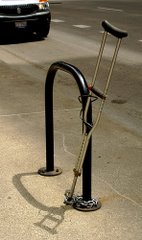
We last left the “So, Courageous!” argument between the spider and the fly with the spider about to critique the portrayal of peoples with disabilities in the media. Let’s resume:
“Fly, you said you found stories of the disabled in the media truly inspirational, but I think that the media takes advantage of the disabled to sell stories of hope. These are not genuine portrayals of peoples’ lives but rather are personal events edited into a feel-good paradigm. For instance, if this little Russian orphan with no legs can get a black belt in Karate, think of what you the audience could accomplish. There is nothing wrong with hopeful messages. Hope is a wonderful thing, but when the majority of stories about peoples with disabilities happen to fit this paradigm, I grow suspicious. Maybe these are not just random occurrences but a systematic and detrimental manipulation of peoples with disabilities in media.” Said the Spider to the Fly.
“But Spider, media presents many hopeful stories, not just about peoples with disabilities. If people felt these were distasteful, they would speak up, or not desire the programming." Said the Fly to the Spider.
“That's true Fly, and personally I find just about all these hope-filled stories distasteful. They feel like inspirational candy that is overly sweet to the taste, leaving me with a fleeting enjoyment as I ingest it followed by a predictable pain in my stomach and regret for having succumbed to the temptation. Many human stories in today’s world of fast paced media tend to be abbreviated to an artificial level so that they no longer seem genuine, but rather become a tool to sell a newspaper or advertising space. Hope sells because we all want to believe great things can happen, and these stories often reinforce that sense. Peoples with disabilities are a target to fill such stories because the dramatic and unusual challenges they face make their individual achievements even more inspiring. The able bodied population apparently finds nothing wrong when peoples with disabilities are constantly presented as a the final hope inspiring act to close out the 5 o'clock news. The population must be educated to see how limited their experience is of the disabled, and to demand a more respectful way of representing these people in their community. So to address your thoughts fly, that the media present genuine inspirational stories, I say, at what cost? How many peoples’ stories are being manipulated and edited to fit this pattern? Why aren’t other stories of disability being shown?" Said the Spider to the Fly.
Saturday, November 24, 2007


Penny for your thoughts...
... well not really, but I would like your thoughts.
I am thankful that you’ve found this blog and find it interesting enough to return every now and then. You are all people who’ve encountered disabilities in your day to day lives. Some of you even write your own blogs about disabilities and have strong opinions on the topic. I see this blog as unique in the disability blogosphere because it attempts to facilitate discussion between different points of view; however few of you have offered your own opinions as comments here on Abled. Please take a moment to post your own thoughts and contribute to the discussion. The best way for me to ferret out the subtleties of these complex human issues is to listen to your frank gut reactions. I can’t do it without you and I have so much to learn. Thanks for your continued support.
I am thankful that you’ve found this blog and find it interesting enough to return every now and then. You are all people who’ve encountered disabilities in your day to day lives. Some of you even write your own blogs about disabilities and have strong opinions on the topic. I see this blog as unique in the disability blogosphere because it attempts to facilitate discussion between different points of view; however few of you have offered your own opinions as comments here on Abled. Please take a moment to post your own thoughts and contribute to the discussion. The best way for me to ferret out the subtleties of these complex human issues is to listen to your frank gut reactions. I can’t do it without you and I have so much to learn. Thanks for your continued support.
Friday, November 9, 2007
Testimonial of the Day #3
From Miss Crip Chick, an awesome poem on Ifs, also the subject of a new blog carnival:
I’ve never known how to embrace If
Funny since I was born an idealist
& Never have been one of those practicing realists
Maybe this no-ifs-policy is a defense mech’
‘Cause once If gets started,
It becomes a running faucet of unanswerable questions.
Like what if I wasn’t disabled?
Maybe I’d be rich;
after all, I wouldn’t have to stay under the poverty level
in order to keep insurance that would cover my home health nurses
Maybe I’d go to a nice school in Washington…
but I’m not sure I’d be interested in politics
if it didn’t affect me as much
So is that even a fair question to ask?
I am disabled just like I’m female
Just like I’m queer
Just like I’m Korean
Just like I’m 20 years old
There are no ifs about it.
Yet non-disabled people enjoy summing this up as not having “hope”
(that’s their reasoning for why a lot of us are anti-stem cell)
But the thing is…
I have hope– lots of it.
Hope for a community that actually recognizes it’s a community
Hope for an end to my current state of unhappiness
Hope for justice, pride, solidarity.
I just don’t waste my hope on silly things
Like wishing I could walk again.
Funny since I was born an idealist
& Never have been one of those practicing realists
Maybe this no-ifs-policy is a defense mech’
‘Cause once If gets started,
It becomes a running faucet of unanswerable questions.
Like what if I wasn’t disabled?
Maybe I’d be rich;
after all, I wouldn’t have to stay under the poverty level
in order to keep insurance that would cover my home health nurses
Maybe I’d go to a nice school in Washington…
but I’m not sure I’d be interested in politics
if it didn’t affect me as much
So is that even a fair question to ask?
I am disabled just like I’m female
Just like I’m queer
Just like I’m Korean
Just like I’m 20 years old
There are no ifs about it.
Yet non-disabled people enjoy summing this up as not having “hope”
(that’s their reasoning for why a lot of us are anti-stem cell)
But the thing is…
I have hope– lots of it.
Hope for a community that actually recognizes it’s a community
Hope for an end to my current state of unhappiness
Hope for justice, pride, solidarity.
I just don’t waste my hope on silly things
Like wishing I could walk again.
Tuesday, November 6, 2007
Testimonial of the Day #2
Take a look a this post from David over at Growing up with a Disability: Milemarker-Mania
David challenges all of us to have the same expectations of him as we do of ourselves: that we have a rich, meaningful, and impassioned life, full of dreams and ambitions. A disability does nothing to change that.
Monday, November 5, 2007
So Courageous! Disability in the Media: Act 4 The Fly and the Spider
The ‘So Courageous’ Phenomenon (SCP), in which peoples with disabilities are praised and appreciated for their accomplishments more than their able bodied peers, is a complex issue. The phenomenon is present in daily interactions between peoples with disabilities and the able bodied. It is also a common way of portraying disability in the media. Many SCP events provide fodder for the harangues of disability bloggers, yet the able bodied population who sponsors the SCP seem undeterred to their critiques. I wanted to explore the issue more thoughtfully and present the reasonable ideas that result in declaring some people with disabilities “Inspirations to us all…” etc. as well as the reasonable ideas for why that is a harmful sentiment.
.jpg) To begin our discussion, let’s take the perspective of the common able bodied person (The Fly in our example) on portraying peoples with disability in the media. Then we will see-saw back to the activist perspective (The Spider) and so forth. Please add your own comments to continue the discussion!
To begin our discussion, let’s take the perspective of the common able bodied person (The Fly in our example) on portraying peoples with disability in the media. Then we will see-saw back to the activist perspective (The Spider) and so forth. Please add your own comments to continue the discussion!
‘It is admirable that with a greater number of challenges in life, peoples with disabilities have been able to achieve great things. When we give them positive attention for these accomplishments, it is to recognize their extraordinary effort and remarkable determination. They should be honored for these accomplishments. Media coverage of these moments also helps support a more positive social outlook on disabilities instead of focusing on negative results of limitations.’ Said the Fly to the Spider.
‘I disagree. Most media portrayals of peoples with disabilities are distasteful because their appreciative angle is usually rooted in a hidden foundation of pity. Society has had low expectations of peoples with disabilities because they pity their condition and find it inherently “deficient”. The only reason the media finds it worthy to celebrate these people is because everyone is surprised that someone with such “disadvantages” has been able to achieve what normal people can. Because this “positive” sentiment stems from a very pitiful perception of the disabled, I find it unappealing. People should be educated to get beyond this simplistic and harmful view.’ Said the Spider to the Fly.
‘I don’t think I pity the disabled? I find them truly inspirational. I find the stories I read in the media compelling because of the hopeful tales of success. Take for instance this story of a kid who became a black belt in Karate even though he doesn’t have any legs. That is acceptably inspirational. It is an amazing story about a kid who did remarkable things even though he had remarkable impediments to success. There’s nothing wrong with being inspired by the true stories of others.’ Said the Fly to the Spider.
‘Ah, that’s just because of how the media packages the stories of the disabled…’ Said the Spider to the Fly.
See next week’s post for Spider’s thoughts on the media and the conclusion of this discussion.
.jpg) To begin our discussion, let’s take the perspective of the common able bodied person (The Fly in our example) on portraying peoples with disability in the media. Then we will see-saw back to the activist perspective (The Spider) and so forth. Please add your own comments to continue the discussion!
To begin our discussion, let’s take the perspective of the common able bodied person (The Fly in our example) on portraying peoples with disability in the media. Then we will see-saw back to the activist perspective (The Spider) and so forth. Please add your own comments to continue the discussion!‘It is admirable that with a greater number of challenges in life, peoples with disabilities have been able to achieve great things. When we give them positive attention for these accomplishments, it is to recognize their extraordinary effort and remarkable determination. They should be honored for these accomplishments. Media coverage of these moments also helps support a more positive social outlook on disabilities instead of focusing on negative results of limitations.’ Said the Fly to the Spider.
‘I disagree. Most media portrayals of peoples with disabilities are distasteful because their appreciative angle is usually rooted in a hidden foundation of pity. Society has had low expectations of peoples with disabilities because they pity their condition and find it inherently “deficient”. The only reason the media finds it worthy to celebrate these people is because everyone is surprised that someone with such “disadvantages” has been able to achieve what normal people can. Because this “positive” sentiment stems from a very pitiful perception of the disabled, I find it unappealing. People should be educated to get beyond this simplistic and harmful view.’ Said the Spider to the Fly.
‘I don’t think I pity the disabled? I find them truly inspirational. I find the stories I read in the media compelling because of the hopeful tales of success. Take for instance this story of a kid who became a black belt in Karate even though he doesn’t have any legs. That is acceptably inspirational. It is an amazing story about a kid who did remarkable things even though he had remarkable impediments to success. There’s nothing wrong with being inspired by the true stories of others.’ Said the Fly to the Spider.
‘Ah, that’s just because of how the media packages the stories of the disabled…’ Said the Spider to the Fly.
See next week’s post for Spider’s thoughts on the media and the conclusion of this discussion.
Tuesday, October 30, 2007
So Courageous! Disability in the Media: Act 3 The "UnCourageous"
I've posted before about the So Courageous Phenomenon (Act 1) and have given some media examples where it occurs (in Act 2). As an antidote, I wanted to show some instances of disability coverage by the media that I am more comfortable with because it is not rooted in pity.
This music video by the band Sigur Ros (one of my favorites) features people with Down Syndrome. I find it beautiful. Unlike the examples above, it does not present on these people in a manufactured positive light. It just features them and lets them be who they are… in angel costumes.
I think this story about a boy in a wheelchair getting attached accidentally to the front of a truck and being driven several miles unharmed, is powerful more for the Wow! factor, than for celebrating anything the boy accomplished. We’re all just glad he survived, and awestruck at what a ride that must have been.
I’ve blogged before about the Color Purple but I want to point it out in this context even though it isn't about disability. This story of entirely African American characters set in the post civil war south does not at all invoke overcoming the plight of slavery. Its power comes from presenting sincerely courageous characters who impress us due to the humanity of their lives, not the context of their situation. By refusing to enter that politically charged issue, the story is much stronger and relates to all people.
I heard a lot about Heather Mills being on dancing with the stars with her prosthetic leg. When I went to research it I was sure that the judging would be sappy and awful. Surprisingly, they did not really play up the SCP in this clip. They addressed her disability, but she didn’t get too much praise just because of it. She even got some honest criticism based on her disability. This may have been an isolated case however in the Heather Mills Dancing with the stars saga. The other shows after this one and the media coverage surrounding it seem more and more "Courageous".
As the least courageous (and hopefully not tasteless) bit I’ve found, here’s an interpretation of the previous video with what could have happened to Heather Mills…
This music video by the band Sigur Ros (one of my favorites) features people with Down Syndrome. I find it beautiful. Unlike the examples above, it does not present on these people in a manufactured positive light. It just features them and lets them be who they are… in angel costumes.
I think this story about a boy in a wheelchair getting attached accidentally to the front of a truck and being driven several miles unharmed, is powerful more for the Wow! factor, than for celebrating anything the boy accomplished. We’re all just glad he survived, and awestruck at what a ride that must have been.
I’ve blogged before about the Color Purple but I want to point it out in this context even though it isn't about disability. This story of entirely African American characters set in the post civil war south does not at all invoke overcoming the plight of slavery. Its power comes from presenting sincerely courageous characters who impress us due to the humanity of their lives, not the context of their situation. By refusing to enter that politically charged issue, the story is much stronger and relates to all people.
I heard a lot about Heather Mills being on dancing with the stars with her prosthetic leg. When I went to research it I was sure that the judging would be sappy and awful. Surprisingly, they did not really play up the SCP in this clip. They addressed her disability, but she didn’t get too much praise just because of it. She even got some honest criticism based on her disability. This may have been an isolated case however in the Heather Mills Dancing with the stars saga. The other shows after this one and the media coverage surrounding it seem more and more "Courageous".
As the least courageous (and hopefully not tasteless) bit I’ve found, here’s an interpretation of the previous video with what could have happened to Heather Mills…
Monday, October 29, 2007
So Courageous! Disability in the Media: Act 2 Exhibits
Here I present some instances where the So Courageous phenomenon (SCP) is exhibited in the media. These stories are packaged in such a way to deliver a hopeful message of success about people with disabilities. I summarize the basic storyline of all these pieces as “Despite the disadvantages they were born with, this inspiring person has achieved great success.” The stories are built on the underlying assumption of very low expectations for the disabled person (what I would call pity). This initial feeling then provides the basis for extolling their accomplishments, which if not for their disability, wouldn’t be so remarkable or newsworthy.
I should be clear that I find absolutely no fault with the people in these stories. The bone I'm picking is with the media coverage and the public reactions it elicits.
“Courageous”
Josh Blue is a comedian who competed on Last Comic Standing who also has Cerebral Palsy. He is very funny and very cool. I just get a weird vibe from the crowd. Their standing ovations seem based on the So Courageous mentality, celebrating him on what he has achieved relative to his condition. Josh wisely plays this to his advantage, part of why he is so successful.
Coverage of Aimee Mullins, an actress, model, and runner who has two prosthetic legs has definitely played up how amazing her achievements are… considering that she doesn’t have any legs. Are they wrong? No… but the tone is still rooted in low expectations and pity for not having legs. Read a deeper analysis here from The Gimp Parade.
But what about the children! They are used probably most often as courageous inspirations in news media. In this example one boy is the star on his football team even though one of his arms is underdeveloped. Not inspired yet? How about this one of a boy who has obtained a black belt in karate even though he has two prosthetic legs.
Well if you’re still not weeping for the hope-filed visions these stories have painted, time to bring out the big guns. Christopher Reeve is the king of SCP. Just read this inspirational biography of him. What’s more is that media didn’t have to create this story, Reeve did it himself and used his inspirational pull with people to fund-raise for a “cure”. Here’s a great South Park parody of him (highly offensive).
In that same south park episode, Timmy and Jimmy are presented in a decidedly "UnCourageous" way. Stay tuned for more on that...
Does this give you a sense for what I mean by the So Courageous Phenomenon?
I should be clear that I find absolutely no fault with the people in these stories. The bone I'm picking is with the media coverage and the public reactions it elicits.
“Courageous”
Josh Blue is a comedian who competed on Last Comic Standing who also has Cerebral Palsy. He is very funny and very cool. I just get a weird vibe from the crowd. Their standing ovations seem based on the So Courageous mentality, celebrating him on what he has achieved relative to his condition. Josh wisely plays this to his advantage, part of why he is so successful.
Coverage of Aimee Mullins, an actress, model, and runner who has two prosthetic legs has definitely played up how amazing her achievements are… considering that she doesn’t have any legs. Are they wrong? No… but the tone is still rooted in low expectations and pity for not having legs. Read a deeper analysis here from The Gimp Parade.
But what about the children! They are used probably most often as courageous inspirations in news media. In this example one boy is the star on his football team even though one of his arms is underdeveloped. Not inspired yet? How about this one of a boy who has obtained a black belt in karate even though he has two prosthetic legs.
Well if you’re still not weeping for the hope-filed visions these stories have painted, time to bring out the big guns. Christopher Reeve is the king of SCP. Just read this inspirational biography of him. What’s more is that media didn’t have to create this story, Reeve did it himself and used his inspirational pull with people to fund-raise for a “cure”. Here’s a great South Park parody of him (highly offensive).
In that same south park episode, Timmy and Jimmy are presented in a decidedly "UnCourageous" way. Stay tuned for more on that...
Does this give you a sense for what I mean by the So Courageous Phenomenon?
Subscribe to:
Posts (Atom)