ABLED

This blog is about reconciling the two worlds of disability understanding. On one side are the strong voices of activists in the disability community. On the other is the well meaning but naïve/ ignorant able bodied population who see disability as something pitiable. As an able bodied person who has realized the very compelling and interesting arguments about society and life coming from the disability community, I am compelled to referee the exchanges between the two sides. Often times it seems that everyone is speaking so loudly and with such great conviction that the other doesn't even listen. Since I am not personally motivated by either side, I can weigh both sides of the arguments and hopefully facilitate an open and accepting space for both sides to express themselves and learn about each other. Please join the discussion!

Friday, March 28, 2008

Good Disability Coverage

The New York Times had an article about the state's new governor, and I was pleased to see good coverage of a person with a disability.

"Mr. Paterson spent the weekend drafting the speech, rehearsing it and committing it to memory. Because he is legally blind, he does not have the luxury of being able to read from a teleprompter. So his remarks will be partly memorized and partly improvised, aides said."

This is good coverage because this was really the only mention of his blindness in the whole article. It doesn't gloss over it, but it also doesn't make it a big deal. The same is true of the article in the Chicago Tribune.

"ALBANY, N.Y. - David Paterson was officially sworn in as New York's governor on Monday, becoming the state's first black chief executive and vowing to move past the prostitution scandal that has rocked the state Capitol. Paterson, who is legally blind, was interrupted at several times during his address with thunderous applause. Before he gave his inaugural address, lawmakers in attendance gave him a two-minute standing ovation and chanted his name: "David! David! David!"'

See media... that wasn't so hard, was it?

In an article entitled "So What about the Blind Thing" in New York Magazine, they notice the lack of disability centric coverage.

"So far, David Paterson's blindness has really only cropped up as an aside in news stories about New York's soon-to-be governor. They're all, 'he's 53 and he's an adjunct at Columbia and he lives in Harlem and he is African-American and oh, yeah, also he is legally blind.' "

I am glad that disability was so overlooked that a publication found it noteworthy to point it out. Its very affirming for me to see. However, this was an easy one. People will always be interested in a new governor. The story doesn't need to depend on disability to make people read it, and therefore disability appropriately fades into the background.

What I wish people would accept is that nobody's story should depend on disability to make people read it. However, for some reason we want to read about people inspiring us, even me, and people with disabilities are easy targets for those stories...

Friday, February 29, 2008

Eating my own words

I'm torn about how to deal with this story in the New York Times. It has 'So Courageous!' written all over it, but I can't help but love it.

"[Dustin] Carter, 18, is a 103-pounder whose legs end at his hips, whose right arm stops just after his elbow and whose left arm is even shorter." In this story we learn that he has won enough matches to go onto the Ohio Division II wrestling competition.

Dustin of course eschews being treated differently even though the article implicitly does so by calling him out for his accomplishment. Given my normal track record on these stories, I expected to snub this story but I just couldn't see it the same way. I think that the written article does fit the pattern that I've discussed before. However, I think I'm able to see past the so courageous, 'my hero', and 'miracle' stuff that the story conveys, to a simpler story, one where a young man achieved something that he cared deeply about. Forget about his special challenges. Let's praise him because he accomplished his dream. How could you not be moved by that...

"When time finally ran out during his consolation semifinals match against Dustin Davidson, the scoreboard showed a 3-1 victory for Carter. Knowing the victory had landed him in the state tournament, he scurried to the middle of the mat, lifted his head toward the ceiling and roared. Not once, but twice.

'I’ll never forget it,' Carter said. 'I’ve been waiting for this too long. It was my last chance. I’ve been struggling to sleep all weekend. I’ve been dreaming about my matches. It’s stayed in my head too long. That was everything coming out.'

His family, wearing buttons with pictures of Carter, surrounded him as he galloped to his father and leaped into his arms. They cried into each other’s shoulders. The friends and family who surrounded them shed tears, as well.

'I don’t think I’ve ever felt such elation in my life,' Lori Carter said, struggling to keep her voice steady. 'He’s worked so hard. After everything he’s been through, he deserves his dream.' "

That's the real story here.

Tuesday, February 12, 2008

So Courageous! Disability in the Media: Act 7, A Vision for the Future

For months now, I have railed against the media for what I see as the limited, ignorant, and harmful way peoples with disabilities are often portrayed in the media. I wanted now to offer a simple vision of how things could be.

Principle 1: The media offers great power to increase awareness; use it. Peoples with disabilities should be frequently presented in media stories. Media offers a valuable channel through which to make the general population familiar and comfortable with, the visual indicators of disability. This principle is already widely accepted, and peoples with disabilities are frequently presented in the media. This should continue.

Principle 2: Educate through example. If we want peoples with disabilities to be treated the same as everyone else, then we must present them in the media the same way as everyone else. Stories should be about something notable or interesting they accomplished to further (or detract from) their community or a particular idea, or any subject that portrays the person as more than just a disability.

I was very pleased to find an example of my vision already realized in the world, and I wrote a post about it a while ago. Kudos to Crains Chicago Business for hitting the nail on the head. This story is about a man opening a new bank that would be designed to serve disabled people or those who have trouble leaving their homes. It is presented as a new idea which might find a strong market. It is also mentioned that the entrepreneur has a disability.

This story is a great example because it treats the man with respect and dignity by calling attention to him for his good idea. It is also a good example because by no means does it skirt around the issue of the disability. By so doing, the story sets an example of treating members of the disabled community the same as everyone else. It also gives visibility to this community which subtly educates the able bodied population. The story shows by example that we are all more the same than we are different, that our differences do make us who we are, but that we are still fundamentally human beings and should never be reduced to anything less than that. Oh, that all media could be like that... maybe in the future...

Sunday, February 10, 2008

So Courageous! Disability in the Media: Act 6 On the Front Lines

Thanks to Ruth at Wheelie Catholic for this story about being interviewed as a disabled tennis player. She recounts her frustration with never being seen as more than a disabled person that played tennis. Reporters weren't interested in the rest of her life or who she was.

"There was no way, it seemed, to get across the real story which was that I played wheelchair tennis as a weekend warrior, competing at tournaments during the spring and summer for short two or three day trips, while working. The reporters didn't want to hear about my other life - the real job I had and all the other things I did with my life.

Such mundane facts seemed to put them on overload. One reporter put his pen behind his ear and just stopped writing. Another held up her hand and asked "Do you all play tennis or do you have a job? Which is it?" as if I couldn't do both. The resistance to any real facts or information was pretty strong.

Somehow no reporter ever managed to write a story about who I was over the decade I gave interviews. I guess that story just wasn't inspirational enough.

You see, I'm not really a wheelchair jock. I practically flunked gym in school. The only reason I have a wall of trophies for wheelchair tennis is because after my hands were paralyzed and I couldn't play classical guitar any more I got so mad I duct taped a racket on and started hitting tennis balls around one day. A coach saw me. He mistook my anger for athletic aspiration and set me up with lessons. And the next thing I knew I found myself competing in a tennis tournament.

That's the real story.

Oh, except for one thing. I managed to win a cross country skiing event too one year. How did that happen?

Don't even ask. But there is an article about it somewhere. And you can bet it was very inspirational."

Its great to have the subject's perspective on the So Courageous Phenomenon. Reporters don't really want to get to know them, they just have a story to tell and need information to support it. I'm sure most reporters do this with all their stories, not just with those concerning the disabled, but it's kind of scary to think that we can all be so quickly reduced to cleanly packaged inspiration and hocked on the media markets to attract viewers.

Thursday, February 7, 2008

Today in Awesome: Ski Chair

Unsafe at any speed.

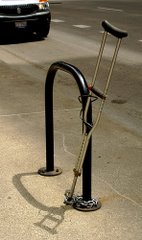
This ranks right up there with the crutch locked to the bike rack in my profile photo.

[Visual description: A white wire-framed chair with a handicapped symbol on it and fastened to yellow skis on the bottom]

Tuesday, January 29, 2008

You are what you talk about

I recently saw this post at Planet of the Blind and wanted to share it with you. I'm always pleased when other people echo the ideas I'm trying to convey. Thanks Stephen!

"...Over time the mere act of talking about the conditions of marginalization becomes a secondary form of abjection... No sensible person would advocate avoiding the use of civil rights language, whether we’re talking about women’s rights or Latina rights or African-American rights, or children’s rights. Yet it seems to me that I am increasingly uncomfortable as a representative of "the disabled community" or "the blind community"—not because I would eschew these political realities, but because the insistence that these are my subjects prevents me from being publicly a more reflective or complex person. I have a sensibility that’s different from what you might suppose... I am not a blind person when I listen to the opera or swim in the Baltic...My feeling is that we must go beyond identification based on race or disability or ethnic origin or gender or sexual orientation for only in so doing can we rebuild a progressive and thoughtful means of public engagement in our nation..."

I couldn't agree more. One thing that I'm particularly interested in is the way we might accomplish this. How do we advocate for disability rights while at the same time not being a person whose sole persona is "Mr./Mrs. Disability"? How do we change something without talking about it?

The only answer I have is to initiate change by example, or as Ghandi said, "Be the change you want to see in the world." One of these days I'll get around to showing you what I mean.

Wednesday, January 23, 2008

Book Review: The Speed of Dark

The Speed of Dark, by Elizabeth Moon, is built around the question, “What would happen if we had a cure for autism?”. Knowing that the issue would be the central debate of this novel made me suspicious, fearing that it would overdo the disability angle and result in some sappy conclusion. Initially the argument was overpoweringly obvious, but soon the characters overshadowed it and took me to a surprising place.

The narrative was crucial to teasing out all the subtleties hidden in the question I raised above. The resulting discussion was honest, subtle, and comprehensive. Ms. Moon used characters to represent different points of view e.g. the boss who thinks the autistic workers would be better off without their disability, or the friend who sincerely appreciates the main character for who he is, autism included. These characters are one-dimensional and don’t make for the best literature, but they facilitate the discussion.

Here's the dilemma. If we tell people with disabilities they the are just as valuable as anyone else, then when the option of a cure is introduced, can we ask them to take it? In most respects, the cure could “improve” their lives, but if there wasn’t anything wrong with their lives before, then why should they change? There is a great quote in the book that highlights this dilemma. “If someone told the last maples that they could change and live happily in the warmer climate, would they choose to do it? What if it meant losing their translucent leaves that turn such beautiful colors every year?”

Toward the end of novel, I forgot that it was exploring this conundrum and focused on the very human, multidimensional, main character making choices about his life, the way anyone would. In my past foray into disability literature with Planet of the Blind, I was impressed because while the book educated about disability, it also related on a simply human level; a fundamental commonality that we all share but which seems to be sometimes overlooked in the presence of disability. The Speed of Dark happily achieved the same connection because of the strength of the main character. Ms. Moon does an excellent job conveying his autistic style through the text, and I found myself quickly growing accustomed to it and feeling like I knew him. The greatest reward from this book is to go on a journey with the main character, see the choices he makes and why, and become more intimately connected with someone with autism. As for the greater question, we are left with a more complete understanding, but gladly no answer.

Monday, January 21, 2008

Understanding Pity

Pity is a hot topic on the disability blogs, usually in the context of “I don’t need your…”. Only recently did I come to a personal understanding of what pity was, and it had nothing to do with disabilities.

Over time, I’ve come to understand a certain friend of mine to be pretty annoying and sometimes impolite and rude. I call him a friend because I had always made conversation with him, found him at times interesting, participated in social events with him, and helped him when times were tough. This friend had been slowly wearing down my nerves as he unabashedly refocused all attention on himself. He would be selfish and sometimes mean, all for the sake of commanding attention. Now lest the pot be calling the kettle black, I also enjoy when attention is focused on me, but I understand that desire and try to keep it in check. This friend was not aware of what he was doing.

At one social event recently, the negative sides of his personality shone much more brightly than the positive ones, and I was not the only one upset with him. We tried as best we could to be polite and engage him gently even though he provoked us and made harsh and unnecessary accusations against those he called his friends.

In this most extreme of situations, I had the realization that surely the only thing that could drive someone to act this way was a deep need for attention, love, and friendship. It was at that moment that I decided to really be his friend. I could have given up on him, angry from his taunting. But instead I saw how much he needed someone, and how sad his situation was, to be so lonely and needing to be loved that he would go to such extremes. So instead of hating him, I felt sorry for him because he could not see the painful root of his actions.

In later reflection, I realized that this was an act of pity, a loving act where I claimed to know him better then he knew himself, and excused him for the wrongs he had done.

So how does this experience relate to disabilities? Many able bodied people see the disabled as people wearing their flaws on their sleeve, and they are compelled to help, to sympathize, and to show pity. The pity itself is not the problem. It is their presumption that a person with a disability has a problem, a flaw, something to be ashamed of, or be embarrassed about. They don’t realize that peoples with disabilities lead normal lives.

Therefore the fault in the able bodied population is not their impulse of pity, which can be a loving thing when carefully examined and used sparingly. The problem is the premise upon which their pity is founded, that a disability is a flaw. That is what the world needs to unlearn.

Sunday, January 13, 2008

The Limits of Disability Activism

I have spent my time on this blog dreaming of a vision for the disability movement and disability education. My biggest flaw in this is that I have little personal experience with people who have disabilities. I recently came a little closer to understanding this missing piece of my experience. I learned the other side of the vision: the reality of what may never change about people with disabilities in our society.

My Aunt’s dog Sparky, with whom I spent a good bit of time as a child, recently developed a bone cancer requiring his front leg to be amputated. This canine experience with disability is admittedly a simplified version of the human one, but it helped me understand some bigger themes. Upon seeing Sparky the first time without his four legs, I was deeply sad for him. I could not look on him hopping around to retrieve a ball and feel glad, even though he managed quite well on his three legs. Despite all I have said about treating the disabled as equals, I was sad and felt pity for Sparky. I found myself thinking how courageous he is to still be chasing his ball!

I don’t think that any amount of education or societal change will eliminate this reaction towards a dog or a person. Whenever a loved one undergoes a dramatic change like loosing part of their body, we feel for our friend's pain, shudder the thought of that happening to us, and project those scared feelings though pity onto our friend.

This experience brought my own activism (if you could call it that) into focus. We cannot change the fact that we feel sad when our loved ones are hurt or forced into uncomfortable challenges. We can change our expectations of how the world will receive the disabled and provide them with the emotional and civic support (through infrastructure) that they need to reclaim full lives with their disability. That is the goal of our activism. I'm glad I'm not alone!

Monday, December 31, 2007

The Rewards of Mainstreaming Disability Education

Check out this article in today's Wall Street Journal for a story about how a high school succeeded in bringing people with disabilities into the mainstream. Also see here for a special online feature they've published about the same topic.

What I find compelling about this story, especially in light of some comments on an earlier post, is how success was defined in this story. The quick summary of the article is that by including students with disabilities in regular classes, they were empowered to believe that they could succeed. One particular student tried hard but did not pass the required state tests. He was still able to achieve his dream working for the army, if only as a truck driver on base. He is now on a path to his goal of being a combat infantryman or a paratrooper, if he works hard and proves himself.

"Adam says [his high school] educators made him feel his disabilities didn't resign him to isolation or failure. 'Even though I am just a truck driver, I am proud of what I do and what I've become,' he says. 'I believe deep down inside that I have succeeded already.'"

Disabilities in the Media: The next act

As I have written more and more about disabilities on this blog, I have discovered that my thoughts have revolved mostly around how it is covered in mainstream media. For me as an able bodied person, media is the most noticeable place that I see frustrating ideological portrayals of peoples with disabilities.

Separately, I learn from the blogs of other activists how much distress there is about how the able bodied population in the world doesn’t understand peoples with disabilities, and I couldn’t agree more.

The reason I mention these two things together is because I see how pivotal media is to cultural education of the population. For example, I think that the TV show Will and Grace had a very significant impact on how gay men are understood in the general American culture. The show portrayed the character Will as a successful, smart lawyer who was looking for a long term relationship. In many ways that was contrary to the stereotypical gay man. I believe that this portrayal improved the way most Americans understood gay people because they were exposed to a more positive and more realistic example.

Likewise I see that there is great potential for “good” portrayals of peoples with disabilities to affect the way Americans understand the group. I would define “good” here to mean some character that is able to connect with viewers without the barrier of the disability getting between them. As I have posted before, this idea is similar to how The Color Purple erases the barrier of race between the characters and the viewers through a compelling and human storyline.

So while activists should continue to lobby for reforms in government and in their communities, I think it is also imperative for the disability movement that we use media more effectively to teach the population what we want them to understand, that peoples with disabilities are every bit as flawed, dignified, relevant, human, beautiful, funny, dorky, and capable of contributing to the world as anyone.

Wednesday, December 5, 2007

The Limited Connotations of Metaphorical Blindness

In this post at Disability Culture Watch, Simi brings the unfortunate negative connotations of metaphorical blindness.

"Definitions of the word “blind” found in my computer’s Thesaurus support the idea that blindness limits . The terms ignorant, imperceptive, insensitive, irrational, oblivious, obtuse, random, rash, stagger, unaware, unconscious, uncontrolled, unknowing, unplanned and violent came up on my screen. My Roget’s Thesaurus also provided inattentive and purposeless. These meanings lurk under the surface when the word “blind” is used whether on its own, or in pairings, in such phrases as “blind passion”, “blind rage”, “blind justice”, “blind drunk” and “blind faith”."

Only recently, having read Planet of the Blind, do I now understand how unfortunate this seems. These definitions and based on an sighted perspective of how limiting blindness is. But I've come to understand that blindness is beautiful because of how it plays on the imagination and can paint a unique picture of the world.

Think of the beautiful moments created when sighted people have their eyes closed...

-The moments before sleep
-A kiss
-Eating somthing truely delicious
-Listening to beautiful music
-In prayer

When I have had these "blind" experiences, I was in a heightened state, grasping something that sight interfered with. The blindness freed me in those moments from the terrestrial world and let me experience another world.

Think now of how beautifully "blind" could be used metaphorically if we had this connotation in our language.

"She blinded me with her beauty."
"I was blind to my earthly cares."
"The music blinded me into a new realm."
"I was blindingly impressed by that play."

In this example, it should be easy to see how clearly society's negative views of disability permeate our lives. A seemingly innocuous word connotation reveals a blatantly narrow understanding of blindness, even though every person has the capacity to appreciate the beauty of not seeing in a kiss, prayer, etc. Thanks Simi for bringing up the subject and opening up the beautiful metaphors that await me.

Tuesday, December 4, 2007

Uncourageous #1: "New approach to banking for physically disabled"

I have been talking a lot about how poorly peoples with disabilities are covered in media, so I wanted to offer this story as an example of how coverage can be better. Firstly this story isn't at all "inspirational". It doesn't trumpet the person's valor for accomplishing so much even though he has a disability. Rather it quickly moves beyond the characteristics of the person and describes his many successful ventures including a practical and marketable new one to create an online bank especially designed for people with physical disabilities. Why would he do this... not because of the poor people in wheelchairs who can't reach the teller (although it will help them), but because its marketable. What a concept, that you don't have to be purely altruistic to positively affect the disability community. You can help people and be profitable by providing a service that people value! Thanks to Crains Chicago Business for reporting this story in a very "Uncourageous" way.

"Since being diagnosed with multiple sclerosis 16 years ago, Brad Saul has learned there's opportunity in marketing to people like himself. He's established a non-profit that trains the disabled for radio industry jobs and has started a local handicapped-accessible transit service. Now comes his latest and most ambitious idea: Mr. Saul, president of Chicago radio syndicator Matrix Media, is launching a bank catering to disabled people. First Access Bank will operate online only and be compatible with the types of software used by people with vision or hearing disabilities. Mr. Saul, 47, has recruited a New York company that specializes in bank startups, NuBank Group, to manage the financial and regulatory aspects of the enterprise. The bank's application hasn't yet been submitted to regulators, but the organizers intend to open in about a month as a finance company, with deposit and other banking services provided by Town Center Bank in south suburban Frankfort, also a recent NuBank startup. They hope to have approval for the bank itself in early 2009 and will need to raise between $1.8 million and $2.4 million to capitalize it, says NuBank President Dan Hudson. Mr. Saul says First Access will fill a real need. "There's not a single bank in this country — not one — that has an accessible Web site" for all kinds of disabled people, he says. His online bank will permit customers to pay their bills electronically, avoiding the need to write checks and mail bills. It has been very challenging for me, and I rely on my wife to pay the bills and write the checks," Mr. Saul says. In addition, the bank will give customers free access to ATMs, paying the fees charged by other banks itself. One banker agrees that the market for the physically disabled is not adequately served. "There is, I think, some need for it," says Tommy FitzGibbon, executive vice-president at Chicago-based MB Financial Inc. and head of the bank's community development unit. "The issue is, how do you define the need? And how do you get the word out?" Mr. Saul, whose marketing plans include working with non-profit advocacy groups to promote First Access, hopes his efforts will help empower people who can be vulnerable to predators. NuBank initially was skeptical of Mr. Saul's idea, which had been rejected by other banks big and small, Mr. Hudson says. NuBank itself turns down about a third of the proposals it gets, he says. But research into the disabled market convinced him otherwise. He started by visiting bank branches in Chicago and observing. "I asked myself, where are the disabled people in the lobby?" he says. "Why aren't they here?" His conclusion: Banks aren't set up to provide service to the disabled, whether they're blind, deaf or in a wheelchair." -Crains Chicago Business 11/12/07

Saturday, November 24, 2007

So Courageous! Disability in the Media: Act 5 Media Manipulation

We last left the “So, Courageous!” argument between the spider and the fly with the spider about to critique the portrayal of peoples with disabilities in the media. Let’s resume:

“Fly, you said you found stories of the disabled in the media truly inspirational, but I think that the media takes advantage of the disabled to sell stories of hope. These are not genuine portrayals of peoples’ lives but rather are personal events edited into a feel-good paradigm. For instance, if this little Russian orphan with no legs can get a black belt in Karate, think of what you the audience could accomplish. There is nothing wrong with hopeful messages. Hope is a wonderful thing, but when the majority of stories about peoples with disabilities happen to fit this paradigm, I grow suspicious. Maybe these are not just random occurrences but a systematic and detrimental manipulation of peoples with disabilities in media.” Said the Spider to the Fly.

“But Spider, media presents many hopeful stories, not just about peoples with disabilities. If people felt these were distasteful, they would speak up, or not desire the programming." Said the Fly to the Spider.

“That's true Fly, and personally I find just about all these hope-filled stories distasteful. They feel like inspirational candy that is overly sweet to the taste, leaving me with a fleeting enjoyment as I ingest it followed by a predictable pain in my stomach and regret for having succumbed to the temptation. Many human stories in today’s world of fast paced media tend to be abbreviated to an artificial level so that they no longer seem genuine, but rather become a tool to sell a newspaper or advertising space. Hope sells because we all want to believe great things can happen, and these stories often reinforce that sense. Peoples with disabilities are a target to fill such stories because the dramatic and unusual challenges they face make their individual achievements even more inspiring. The able bodied population apparently finds nothing wrong when peoples with disabilities are constantly presented as a the final hope inspiring act to close out the 5 o'clock news. The population must be educated to see how limited their experience is of the disabled, and to demand a more respectful way of representing these people in their community. So to address your thoughts fly, that the media present genuine inspirational stories, I say, at what cost? How many peoples’ stories are being manipulated and edited to fit this pattern? Why aren’t other stories of disability being shown?" Said the Spider to the Fly.

Penny for your thoughts...

... well not really, but I would like your thoughts.

I am thankful that you’ve found this blog and find it interesting enough to return every now and then. You are all people who’ve encountered disabilities in your day to day lives. Some of you even write your own blogs about disabilities and have strong opinions on the topic. I see this blog as unique in the disability blogosphere because it attempts to facilitate discussion between different points of view; however few of you have offered your own opinions as comments here on Abled. Please take a moment to post your own thoughts and contribute to the discussion. The best way for me to ferret out the subtleties of these complex human issues is to listen to your frank gut reactions. I can’t do it without you and I have so much to learn. Thanks for your continued support.

Friday, November 9, 2007

Testimonial of the Day #3

From Miss Crip Chick, an awesome poem on Ifs, also the subject of a new blog carnival:

I’ve never known how to embrace If
Funny since I was born an idealist
& Never have been one of those practicing realists
Maybe this no-ifs-policy is a defense mech’
‘Cause once If gets started,
It becomes a running faucet of unanswerable questions.
Like what if I wasn’t disabled?
Maybe I’d be rich;
after all, I wouldn’t have to stay under the poverty level
in order to keep insurance that would cover my home health nurses
Maybe I’d go to a nice school in Washington…
but I’m not sure I’d be interested in politics
if it didn’t affect me as much
So is that even a fair question to ask?
I am disabled just like I’m female
Just like I’m queer
Just like I’m Korean
Just like I’m 20 years old
There are no ifs about it.
Yet non-disabled people enjoy summing this up as not having “hope”
(that’s their reasoning for why a lot of us are anti-stem cell)
But the thing is…
I have hope– lots of it.
Hope for a community that actually recognizes it’s a community
Hope for an end to my current state of unhappiness
Hope for justice, pride, solidarity.
I just don’t waste my hope on silly things
Like wishing I could walk again.

Tuesday, November 6, 2007

Testimonial of the Day #2

Take a look a this post from David over at Growing up with a Disability: Milemarker-Mania

"One often hears that life is a journey, and that the goal is not to race to the “finish line”, but rather to embrace the whole trip. Yet, when you are a child growing up with a disability, many people, particularly educators and health care providers, focus solely on your milemarkers, as though the milemarkers and the journey are one and the same. Gross motor skills, fine motor skills, speech and language abilities, cognitive skills, academic level, activities of daily living skills, social skills and on and on - it is easy to become consumed with measuring progress against these markers, and take them on as though they were life itself."

David challenges all of us to have the same expectations of him as we do of ourselves: that we have a rich, meaningful, and impassioned life, full of dreams and ambitions. A disability does nothing to change that.

Monday, November 5, 2007

So Courageous! Disability in the Media: Act 4 The Fly and the Spider

The ‘So Courageous’ Phenomenon (SCP), in which peoples with disabilities are praised and appreciated for their accomplishments more than their able bodied peers, is a complex issue. The phenomenon is present in daily interactions between peoples with disabilities and the able bodied. It is also a common way of portraying disability in the media. Many SCP events provide fodder for the harangues of disability bloggers, yet the able bodied population who sponsors the SCP seem undeterred to their critiques. I wanted to explore the issue more thoughtfully and present the reasonable ideas that result in declaring some people with disabilities “Inspirations to us all…” etc. as well as the reasonable ideas for why that is a harmful sentiment.
To begin our discussion, let’s take the perspective of the common able bodied person (The Fly in our example) on portraying peoples with disability in the media. Then we will see-saw back to the activist perspective (The Spider) and so forth. Please add your own comments to continue the discussion!

‘It is admirable that with a greater number of challenges in life, peoples with disabilities have been able to achieve great things. When we give them positive attention for these accomplishments, it is to recognize their extraordinary effort and remarkable determination. They should be honored for these accomplishments. Media coverage of these moments also helps support a more positive social outlook on disabilities instead of focusing on negative results of limitations.’ Said the Fly to the Spider.

‘I disagree. Most media portrayals of peoples with disabilities are distasteful because their appreciative angle is usually rooted in a hidden foundation of pity. Society has had low expectations of peoples with disabilities because they pity their condition and find it inherently “deficient”. The only reason the media finds it worthy to celebrate these people is because everyone is surprised that someone with such “disadvantages” has been able to achieve what normal people can. Because this “positive” sentiment stems from a very pitiful perception of the disabled, I find it unappealing. People should be educated to get beyond this simplistic and harmful view.’ Said the Spider to the Fly.

‘I don’t think I pity the disabled? I find them truly inspirational. I find the stories I read in the media compelling because of the hopeful tales of success. Take for instance this story of a kid who became a black belt in Karate even though he doesn’t have any legs. That is acceptably inspirational. It is an amazing story about a kid who did remarkable things even though he had remarkable impediments to success. There’s nothing wrong with being inspired by the true stories of others.’ Said the Fly to the Spider.

‘Ah, that’s just because of how the media packages the stories of the disabled…’ Said the Spider to the Fly.

See next week’s post for Spider’s thoughts on the media and the conclusion of this discussion.

Tuesday, October 30, 2007

So Courageous! Disability in the Media: Act 3 The "UnCourageous"

I've posted before about the So Courageous Phenomenon (Act 1) and have given some media examples where it occurs (in Act 2). As an antidote, I wanted to show some instances of disability coverage by the media that I am more comfortable with because it is not rooted in pity.

This music video by the band Sigur Ros (one of my favorites) features people with Down Syndrome. I find it beautiful. Unlike the examples above, it does not present on these people in a manufactured positive light. It just features them and lets them be who they are… in angel costumes.

I think this story about a boy in a wheelchair getting attached accidentally to the front of a truck and being driven several miles unharmed, is powerful more for the Wow! factor, than for celebrating anything the boy accomplished. We’re all just glad he survived, and awestruck at what a ride that must have been.

I’ve blogged before about the Color Purple but I want to point it out in this context even though it isn't about disability. This story of entirely African American characters set in the post civil war south does not at all invoke overcoming the plight of slavery. Its power comes from presenting sincerely courageous characters who impress us due to the humanity of their lives, not the context of their situation. By refusing to enter that politically charged issue, the story is much stronger and relates to all people.

I heard a lot about Heather Mills being on dancing with the stars with her prosthetic leg. When I went to research it I was sure that the judging would be sappy and awful. Surprisingly, they did not really play up the SCP in this clip. They addressed her disability, but she didn’t get too much praise just because of it. She even got some honest criticism based on her disability. This may have been an isolated case however in the Heather Mills Dancing with the stars saga. The other shows after this one and the media coverage surrounding it seem more and more "Courageous".

As the least courageous (and hopefully not tasteless) bit I’ve found, here’s an interpretation of the previous video with what could have happened to Heather Mills…

Monday, October 29, 2007

So Courageous! Disability in the Media: Act 2 Exhibits

Here I present some instances where the So Courageous phenomenon (SCP) is exhibited in the media. These stories are packaged in such a way to deliver a hopeful message of success about people with disabilities. I summarize the basic storyline of all these pieces as “Despite the disadvantages they were born with, this inspiring person has achieved great success.” The stories are built on the underlying assumption of very low expectations for the disabled person (what I would call pity). This initial feeling then provides the basis for extolling their accomplishments, which if not for their disability, wouldn’t be so remarkable or newsworthy.

I should be clear that I find absolutely no fault with the people in these stories. The bone I'm picking is with the media coverage and the public reactions it elicits.

“Courageous”
Josh Blue is a comedian who competed on Last Comic Standing who also has Cerebral Palsy. He is very funny and very cool. I just get a weird vibe from the crowd. Their standing ovations seem based on the So Courageous mentality, celebrating him on what he has achieved relative to his condition. Josh wisely plays this to his advantage, part of why he is so successful.

Coverage of Aimee Mullins
, an actress, model, and runner who has two prosthetic legs has definitely played up how amazing her achievements are… considering that she doesn’t have any legs. Are they wrong? No… but the tone is still rooted in low expectations and pity for not having legs. Read a deeper analysis here from The Gimp Parade.

But what about the children! They are used probably most often as courageous inspirations in news media. In this example one boy is the star on his football team even though one of his arms is underdeveloped. Not inspired yet? How about this one of a boy who has obtained a black belt in karate even though he has two prosthetic legs.

Well if you’re still not weeping for the hope-filed visions these stories have painted, time to bring out the big guns. Christopher Reeve is the king of SCP. Just read this inspirational biography of him. What’s more is that media didn’t have to create this story, Reeve did it himself and used his inspirational pull with people to fund-raise for a “cure”. Here’s a great South Park parody of him (highly offensive).

In that same south park episode, Timmy and Jimmy are presented in a decidedly "UnCourageous" way. Stay tuned for more on that...

Does this give you a sense for what I mean by the So Courageous Phenomenon?
 
Add to Technorati Favorites Who links to me?